
News
May 24, 2026
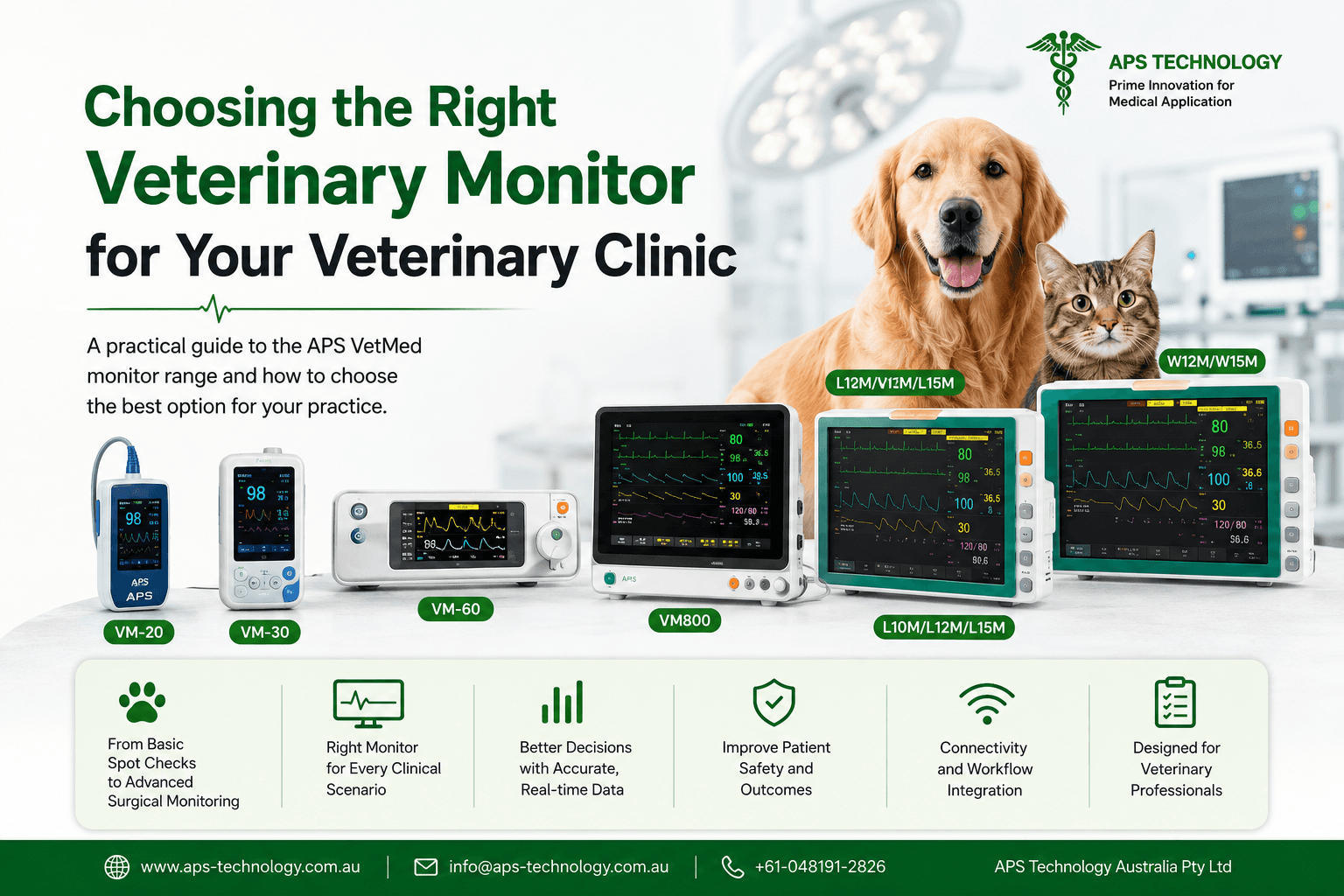
Choosing the Right Veterinary Monitor for Your Veterinary Clinic
Selecting a veterinary monitor can feel confusing because different monitors are designed for different clinical situations. A device that is perfect for quick SpO₂ checks may not be suitable for anaesthesia. A compact monitor may work well in a treatment room, while a referral hospital may need a larger modular system with advanced monitoring options.
This guide is designed to help you understand the APS VetMed veterinary monitor range and choose the most suitable option for your clinic, your patients and your daily workflow.
Whether you are looking for a handheld pulse oximeter, a portable vital signs monitor, a compact bedside monitor, a full multiparameter monitor or an advanced surgical monitoring platform, the key is to match the monitor to the way your clinic actually works.
Why the Right Veterinary Monitor Depends on Your Workflow
Before choosing a monitor, it helps to think about how it will be used.
Are you mainly checking SpO₂ and pulse rate during consultations or recovery? Do you need a portable monitor for mobile visits or triage? Are you monitoring patients during dental procedures or routine surgery? Do you need a larger screen for anaesthesia and recovery? Or do you need a higher-end platform for critical care, emergency work or referral hospital use?
Different clinical workflows require different monitoring levels. For example, a small general practice may need a compact monitor for dental and surgical procedures, while a larger veterinary hospital may need multiple monitors across surgery, treatment and recovery areas.
This guide will help you compare the available options and identify which type of monitor may suit your needs.
APS VetMed Veterinary Monitor Range at a Glance
The APS VetMed range can be understood as a step-by-step pathway, from simple handheld monitoring through to advanced modular monitoring.
Product | Main role | Typical use |
VM-20 Handheld Pulse Oximeter | Basic SpO₂ and pulse monitoring | Spot checks, recovery, mobile use |
VM-30 Handheld Vital Signs Monitor | Portable multiparameter checks | Triage, mobile vet, pre-anaesthetic assessment |
VM-60 Vital Signs Monitor | Compact procedure and recovery monitoring | Dental, treatment room, recovery |
VM800 Veterinary Monitor | Compact bedside multiparameter monitoring | General practice surgery, dental, recovery |
L10M / L12M / L15M Veterinary Monitors | Professional multiparameter monitoring | Surgery rooms, recovery areas, medium-sized hospitals |
W12M / W15M Veterinary Monitors | Advanced modular monitoring | Referral hospitals, advanced surgery, ICU, critical care |
Each monitor has a different role. The right choice depends on your clinical use case, the parameters you need, the available space, screen-size preference, procedure type and budget.
1. VM-20 Handheld Pulse Oximeter
The VM-20 is the most portable and entry-level option in the APS VetMed range. It is designed mainly for SpO₂, pulse rate and basic patient observation.
This type of monitor is useful when you need a quick and simple way to check oxygen saturation and pulse rate without setting up a larger bedside monitor.
Suitable for
· Consultation-room spot checks
· Recovery cage observation
· Nurse rounds
· Mobile veterinary visits
· Basic respiratory and pulse assessment
· Clinics looking for a simple entry-level monitoring device
Where it fits
The VM-20 is best suited to simple, portable monitoring. It may also be useful as a supporting device alongside larger monitors in surgery, treatment or recovery areas.
When you may need a different model
If you also need blood pressure, ECG, temperature, EtCO₂ or longer continuous monitoring, you may want to consider the VM-30, VM-60 or VM800.
2. VM-30 Handheld Vital Signs Monitor
The VM-30 is a step up from a basic pulse oximeter. It remains portable and handheld, but it supports a broader vital-signs workflow.
Depending on configuration, it can support parameters such as SpO₂, pulse rate, temperature, NIBP, ECG and EtCO₂. This makes it useful when you need portability but also want more clinical information than SpO₂ alone.
Suitable for
· Mobile veterinary services
· Emergency triage
· Pre-anaesthetic checks
· Small clinics needing one flexible portable monitor
· Treatment rooms where a full bedside monitor is not always required
· Recovery monitoring where portability is important
Where it fits
The VM-30 is the portable multiparameter option. It offers more capability than the VM-20 while remaining easier to move around than a larger bedside monitor.
When you may need a different model
If the monitor will be used frequently during dental procedures, surgery or longer observation periods, a larger screen monitor such as the VM-60, VM800 or L-series may be easier for your team to use.
3. VM-60 Vital Signs Monitor
The VM-60 sits between handheld monitoring and full bedside multiparameter monitoring. It is compact, portable and suitable for real-time vital signs observation in treatment rooms, recovery areas and procedure settings.
This type of monitor is useful when you need a small monitor with a clearer display, alarm functions, trend storage and connectivity options.
Suitable for
· Dental procedures
· Treatment rooms
· Recovery areas
· Compact surgery spaces
· Clinics needing a small but capable vital signs monitor
· Situations where portability and continuous monitoring are both important
Where it fits
The VM-60 is a good option if your clinic has moved beyond basic handheld checks but does not need a large multiparameter monitor in every room.
When you may need a different model
If you want a larger display, more waveform visibility or a more traditional bedside monitor format, the VM800 or L-series may be a better fit.
4. VM800 Veterinary Monitor
The VM800 is a compact bedside-style veterinary monitor. It is suitable when you need a practical multiparameter monitor for routine procedures, dental work, recovery and general practice surgery.
Compared with handheld units, a bedside-style monitor is easier to view during procedures and can remain positioned in a treatment room, dental area or surgery room.
Suitable for
· General veterinary clinics
· Routine surgery
· Dental anaesthesia
· Treatment-room monitoring
· Recovery monitoring
· Clinics wanting a compact multiparameter bedside monitor
Where it fits
The VM800 is a strong middle option. It is more practical than a handheld device for regular procedures, while still being more compact than larger L-series or W-series monitors.
When you may need a different model
If you need a larger screen, more advanced options or a monitor for higher-acuity surgery and critical care, the L-series or W-series may be more suitable.
5. L10M / L12M / L15M Veterinary Monitors
The L-series is designed for clinics that need a professional multiparameter monitor with larger screen options. The range includes 10-inch, 12-inch and 15-inch models, allowing you to choose the most appropriate display size for your rooms and workflow.
The L-series is suitable for monitoring common surgical and recovery parameters such as ECG, NIBP, SpO₂, respiration, pulse/heart rate and temperature, with optional configurations available depending on requirements.
Suitable for
· Routine surgery rooms
· Dental anaesthesia where a larger monitor is preferred
· Recovery wards
· Medium-sized veterinary hospitals
· Multi-vet clinics
· Clinics needing clear waveform visibility
Model guide
· L10M: Suitable for smaller treatment and procedure rooms.
· L12M: A balanced option for many general veterinary practices.
· L15M: Better for larger surgery rooms, recovery areas or spaces where the screen needs to be visible from a distance.
Where it fits
The L-series is the professional general-practice monitor range. It is a good option when you want a more complete setup than VM800, without necessarily moving to the highest-end modular W-series platform.
When you may need a different model
If you require advanced modularity, critical-care monitoring, central monitoring integration or more specialised parameters, the W12M or W15M may be more suitable.
6. W12M / W15M Veterinary Monitors
The W-series is the advanced veterinary monitoring platform in the APS VetMed range. It is designed for clinics and hospitals that need higher-end monitoring, larger displays, modular parameter options and suitability for surgery, ICU and critical-care environments.
The W12M and W15M are especially relevant if you want a long-term monitoring platform rather than a basic monitor for occasional procedures.
Suitable for
· Referral veterinary hospitals
· Advanced surgery rooms
· Emergency and critical-care departments
· ICU-style monitoring
· Specialist anaesthesia cases
· Clinics requiring advanced parameter options
· Premium practices wanting a higher-end monitoring platform
Model guide
· W12M: Advanced monitoring in a more compact screen size.
· W15M: Premium large-screen option for advanced surgery, ICU and referral hospital environments.
Where it fits
The W-series is the top tier of the APS VetMed range. It should be considered when your clinical workflow is more demanding, your procedures are higher-risk or you want advanced expandability.
Choosing by Clinical Application
Many clinics find it easier to choose a monitor based on use case rather than model number. The table below gives a practical starting point.
Clinical scenario | Suitable APS VetMed options |
Basic consultation checks | VM-20 |
Recovery spot checks | VM-20, VM-30 |
Mobile veterinary visits | VM-20, VM-30 |
Emergency triage | VM-30, VM-60 |
Dental procedures | VM-60, VM800, L12M, W12M |
Routine surgery | VM800, L10M, L12M |
Recovery room monitoring | VM-60, VM800, L15M |
Medium-sized veterinary hospital | L12M, L15M |
Referral hospital | W12M, W15M |
ICU / critical care | W15M, W12M |
This does not mean that only one monitor can be used in each scenario. Instead, it gives you a starting point. Final selection should consider the parameters required, the patient type, the procedure risk, the number of rooms and your budget.
Practical Product Pathways
For a small general veterinary clinic
You may begin with a VM-20 for quick checks and a VM800 for procedure-room monitoring. This gives your clinic basic spot-check capability and a practical bedside monitor for surgery or dental work.
For a mobile vet
If you work across different locations, the VM-30 may be suitable because it offers portability with broader vital signs capability. If you only need oxygen saturation and pulse rate, the VM-20 may be sufficient.
For a dental-focused clinic
Dental procedures often benefit from monitoring oxygenation, blood pressure, temperature, respiration and EtCO₂. Suitable options include VM-60, VM800, L12M or W12M depending on your budget and monitoring depth.
For a growing multi-vet practice
A growing practice may use an L12M or L15M in the main surgery room, a VM800 in the treatment or recovery area, and a VM-20 or VM-30 for quick checks.
For a referral or emergency hospital
A referral hospital may consider W12M or W15M as the primary advanced monitoring platform, supported by VM800 or VM-60 units in recovery or secondary procedure areas.
Final Recommendation
The best veterinary monitor is the one that matches your clinical workflow.
For simple spot checks, the VM-20 may be enough. For mobile and triage applications, the VM-30 provides more flexibility. For procedure rooms and recovery areas, the VM-60 and VM800 offer compact bedside monitoring. For routine surgery and professional general practice monitoring, the L10M, L12M and L15M provide larger-screen multiparameter capability. For advanced surgery, ICU and referral hospital environments, the W12M and W15M provide the highest level of monitoring in the APS VetMed range.
When comparing monitors, consider the type of procedures you perform, how often monitoring is required, which parameters are essential, whether portability matters, and how clearly your team needs to view the screen during patient care.
If you are unsure which monitor best suits your clinic, APS VetMed can help you compare the options and select a configuration that fits your clinical needs.
