
News
Oct 14, 2026
Water quality has always been fundamental to industrial operations, but the way organisations monitor and manage it is evolving rapidly. Across industries such as municipal water treatment, wastewater management, food and beverage production, mining, aquaculture, chemical processing and commercial facilities, there is an increasing shift away from manual sampling towards continuous online monitoring.
This transition is driven by the growing need for operational efficiency, regulatory compliance and real-time decision-making. As industrial processes become more automated, water quality monitoring systems are playing a critical role in helping operators detect changes immediately, optimise treatment processes and reduce operational risks.
WHY TRADITIONAL WATER TESTING IS NO LONGER ENOUGH
Laboratory testing and manual water sampling remain valuable for detailed analysis, but they provide only a snapshot of water conditions at a single point in time.
In many industrial applications, water quality can change rapidly due to:
Equipment failures
Chemical dosing fluctuations
Seasonal variations
Contamination events
Process changes
Variations in raw water quality
When monitoring relies solely on periodic testing, these changes may go unnoticed until they begin affecting production, equipment performance or regulatory compliance.
Continuous online monitoring addresses this challenge by providing real-time visibility into changing water conditions, allowing operators to respond before small issues become major operational problems.
THE VALUE OF MONITORING MULTIPLE WATER QUALITY PARAMETERS
Water quality cannot be defined by a single measurement. Different applications require different combinations of parameters, each providing valuable insight into overall system performance.
Some of the most commonly monitored parameters include:
pH
Maintaining the correct pH is essential for water treatment processes, chemical dosing, corrosion prevention and biological treatment performance. Even small changes in pH can significantly impact process efficiency.
Oxidation Reduction Potential (ORP)
ORP measures the oxidising strength of water and is commonly used to monitor disinfectant effectiveness in drinking water, wastewater treatment and commercial swimming pools.
Conductivity
Conductivity provides an indication of dissolved ions within water and is widely used to monitor water purity, dissolved solids and chemical concentration.
Dissolved Oxygen
Maintaining appropriate dissolved oxygen levels is critical for biological wastewater treatment, aquaculture systems and environmental monitoring, helping support healthy microbial activity and aquatic life.
Turbidity
Turbidity monitoring assists operators in identifying suspended particles, filtration performance and potential contamination issues before they affect downstream processes.
Residual Chlorine
Residual chlorine measurement ensures sufficient disinfection while preventing excessive chlorine concentrations that may impact equipment, water quality or process performance.
Temperature
Many analytical measurements rely on accurate temperature compensation. Continuous temperature monitoring improves overall measurement accuracy and process control.
WHY MODULAR WATER QUALITY MONITORING MATTERS
Every facility has different monitoring requirements.
A drinking water treatment plant may prioritise pH, turbidity and residual chlorine, while a wastewater treatment facility may require dissolved oxygen, ammonia and suspended solids. Industrial process water systems often focus on conductivity, ORP and temperature.
Selecting a modular monitoring platform allows organisations to configure only the sensors they require today while maintaining the flexibility to expand as operational needs evolve.
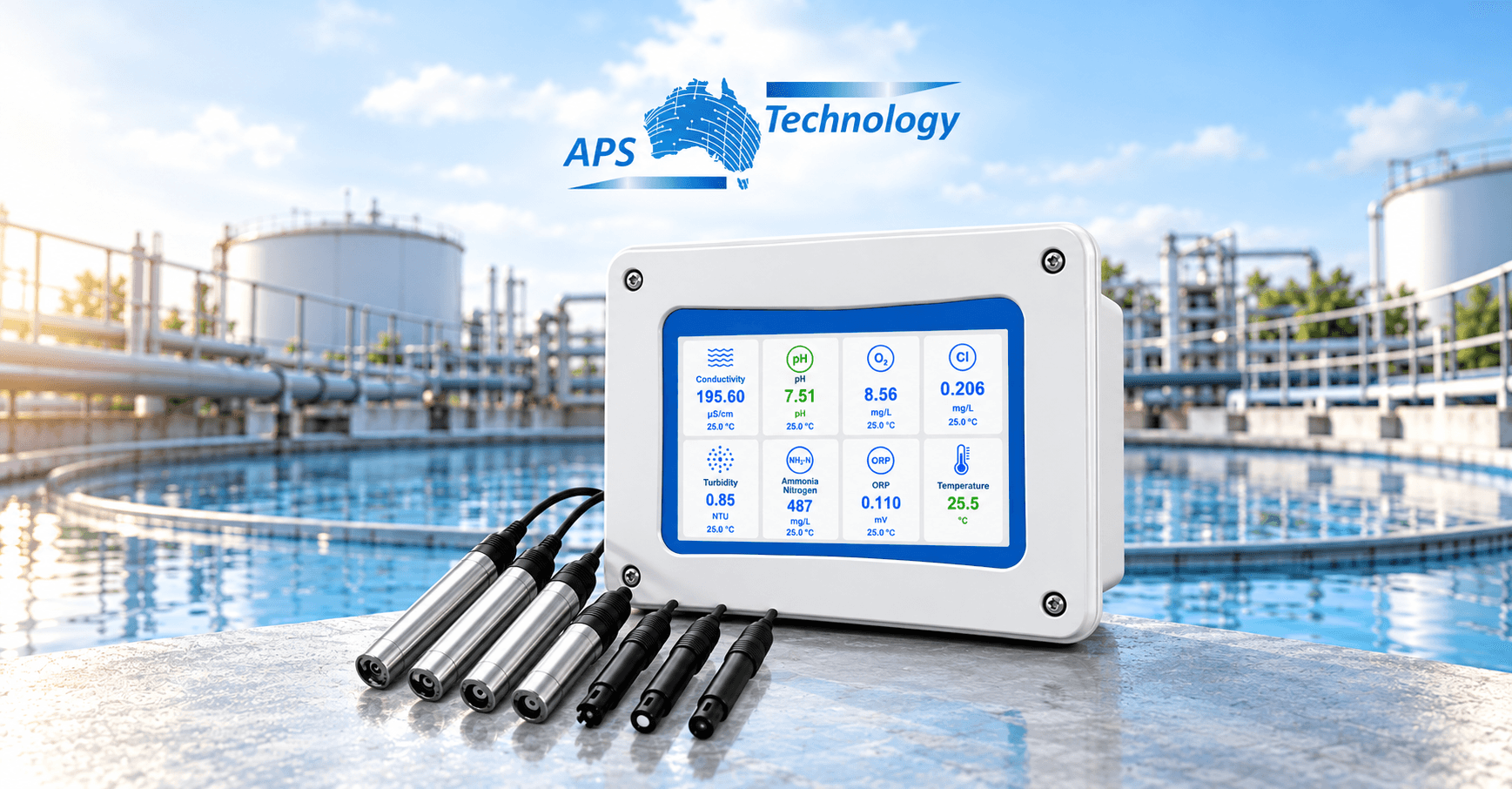
The APS Technology GMWA-1000 Multi-parameter Online Analyzer supports up to seven sensors simultaneously, allowing operators to monitor multiple water quality parameters from a single controller. Its modular architecture enables future expansion without replacing the complete monitoring system, making it a practical solution for growing facilities.
THE IMPORTANCE OF INDUSTRIAL CONNECTIVITY
Modern industrial facilities increasingly rely on integrated automation systems to improve visibility and operational efficiency.
When selecting an online analyser, engineers should consider communication capabilities alongside measurement performance.
Integration with PLCs, SCADA platforms and Building Management Systems (BMS) enables water quality data to become part of a facility's broader automation strategy.
The GMWA-1000 supports industry-standard communication options including MODBUS RS485, programmable 4–20 mA analogue outputs and relay alarms, making integration with existing control systems straightforward. The analyser also features a 7-inch touchscreen interface, IP65/NEMA4X protection and optional wireless communication, supporting reliable operation across a wide range of industrial environments.
APPLICATIONS ACROSS MULTIPLE INDUSTRIES
Continuous online water quality monitoring delivers measurable benefits across numerous industries.
Typical applications include:
Municipal drinking water treatment
Wastewater treatment plants
Commercial swimming pools
Aquatic and leisure centres
Cooling towers
Boiler water systems
Food and beverage manufacturing
Pharmaceutical production
Mining and mineral processing
Chemical processing facilities
Aquaculture
Surface water monitoring
Rivers, reservoirs and environmental monitoring
Each application has unique monitoring requirements, but all benefit from immediate visibility into changing water quality conditions.
MOVING TOWARDS SMARTER WATER MANAGEMENT
Water monitoring is becoming increasingly connected.
Rather than operating as standalone systems, modern water quality analysers are being integrated with flow meters, pump controllers, Industrial IoT platforms and predictive maintenance systems.
This integrated approach provides operators with a more complete understanding of both water quality and overall plant performance.
The result is improved operational efficiency, reduced maintenance costs, enhanced regulatory compliance and more informed decision-making.
As industrial facilities continue their digital transformation journey, investing in scalable and connected water quality monitoring solutions will become an increasingly important part of maintaining reliable and efficient operations.
Whether monitoring municipal water supplies, wastewater treatment processes or industrial production systems, selecting a flexible multi-parameter analyser provides organisations with the confidence to respond quickly to changing conditions while supporting long-term operational performance.
Read more about APS Multi-Parameter Water Quality Analyser - GMWA - 1000
