
News
Jun 11, 2026
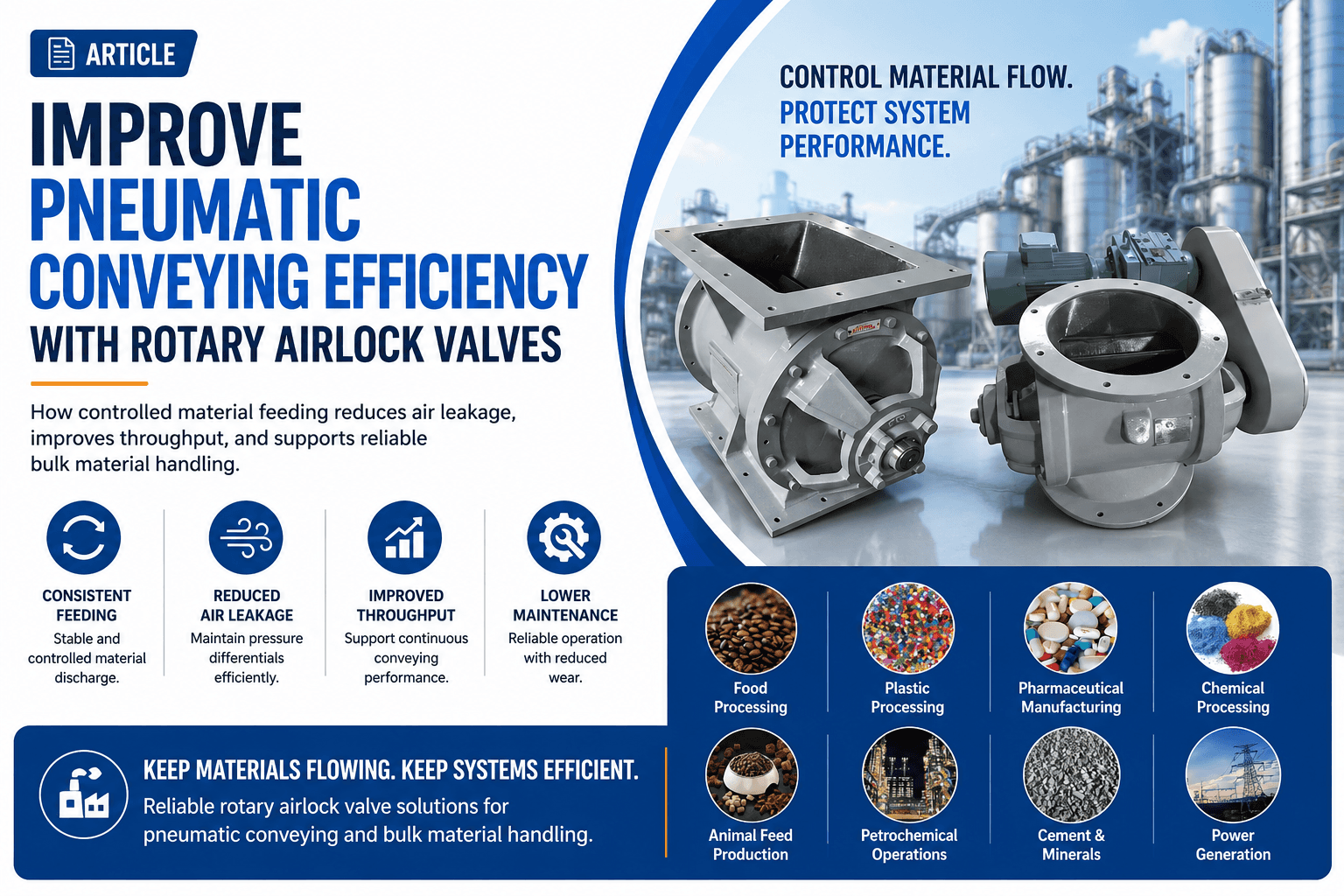
How Rotary Airlock Valves Improve Pneumatic Conveying Efficiency
Bulk Handling | Pneumatic Conveying | Process Automation
In pneumatic conveying systems, reliable material feeding is just as important as airflow.
Many conveying systems experience problems such as inconsistent material flow, excessive air leakage, poor conveying efficiency, increased energy consumption, and equipment wear. While blowers, pipelines, and filters often receive most of the attention, the rotary airlock valve is frequently the component that determines how efficiently the entire system performs.
Rotary Airlock Valves provide a controlled method of feeding powders, granules, pellets, and bulk solids into pneumatic conveying systems while maintaining the pressure differential required for efficient operation.
What is a Rotary Airlock Valve?
A Rotary Airlock Valve is a rotating mechanical feeder that transfers bulk material from one process stage to another while minimizing air leakage between areas operating at different pressures.
The valve consists of a rotor with multiple pockets that continuously receive material from a hopper or silo and discharge it into the downstream process.
Unlike simple discharge valves, rotary airlock valves perform two important functions simultaneously:
· Controlled material feeding
· Airlock sealing between process zones
This makes them an essential component in both pressure and vacuum conveying systems.
Why Airlock Performance Matters
Pneumatic conveying systems rely on carefully controlled airflow.
Excessive air leakage can result in:
· Reduced conveying efficiency
· Higher blower energy consumption
· Material handling instability
· Reduced throughput
· Increased maintenance requirements
A properly selected rotary airlock valve helps maintain the pressure differential required for efficient conveying while ensuring a consistent material feed rate.
Benefits of Rotary Airlock Valves
Consistent Material Feeding
The rotating pockets provide controlled and repeatable material discharge, helping maintain stable conveying conditions.
Reduced Air Leakage
Airlock sealing minimizes unwanted pressure loss between process stages.
Improved System Efficiency
By maintaining proper pressure differentials, conveying systems can operate more efficiently with lower energy consumption.
Continuous Operation
Rotary airlock valves provide uninterrupted material feeding for continuous production processes.
Flexible Material Handling
Suitable for powders, granules, pellets, crystals, minerals, cement, chemicals, food ingredients, plastics, and animal feed.
Rotary Valve Solutions for Different Industries
Different materials require different valve designs.
Standard Rotary Airlock Valves
Suitable for powders and granules used in pneumatic conveying and bulk handling applications.
Blow-Through Rotary Valves
Designed for pneumatic conveying systems where material enters directly into the conveying air stream.
Sanitary Rotary Valves
Used in food, dairy, pharmaceutical, and hygienic processing environments where cleaning and inspection are critical.
Plastic Industry Rotary Valves
Specialized designs for plastic powders, flakes, and pellets.
Abrasive Duty Rotary Valves
Engineered using wear-resistant materials such as ceramic liners, Hardox components, and tungsten carbide coatings.
High Temperature Rotary Valves
Designed for demanding applications involving elevated process temperatures and harsh operating conditions.
Applications
Rotary airlock valves are widely used across:
· Cement and fly ash handling
· Chemical processing
· Food and dairy manufacturing
· Plastic pellet processing
· Mining and mineral handling
· Power generation
· Animal feed production
· Dust collection systems
Beyond Standard Products
At APS Technology, we understand that every material behaves differently.
Factors such as particle size, bulk density, abrasiveness, temperature, moisture content, and conveying pressure all influence valve selection.
That's why APS works with customers to select the appropriate valve configuration, materials of construction, rotor design, and drive arrangement to suit the application.
Conclusion
Rotary Airlock Valves are far more than simple discharge devices.
They play a critical role in maintaining pressure differentials, controlling material flow, improving pneumatic conveying efficiency, and reducing operational costs.
Whether handling cement, chemicals, food products, minerals, plastics, or abrasive powders, the right rotary airlock valve can significantly improve the performance and reliability of a bulk material handling system.
