
Bulk Handling
Mar 21, 2026
Industrial Automation | Remote Connectivity
Modern industrial operations are no longer confined to a single facility. From remote pump stations to distributed water treatment systems, today’s infrastructure depends on continuous, real-time communication across wide and often challenging environments.
However, extending network connectivity to these remote assets is rarely straightforward. Trenching cables across long distances is costly, time-consuming, and often impractical, particularly in outdoor, hazardous, or geographically complex environments.
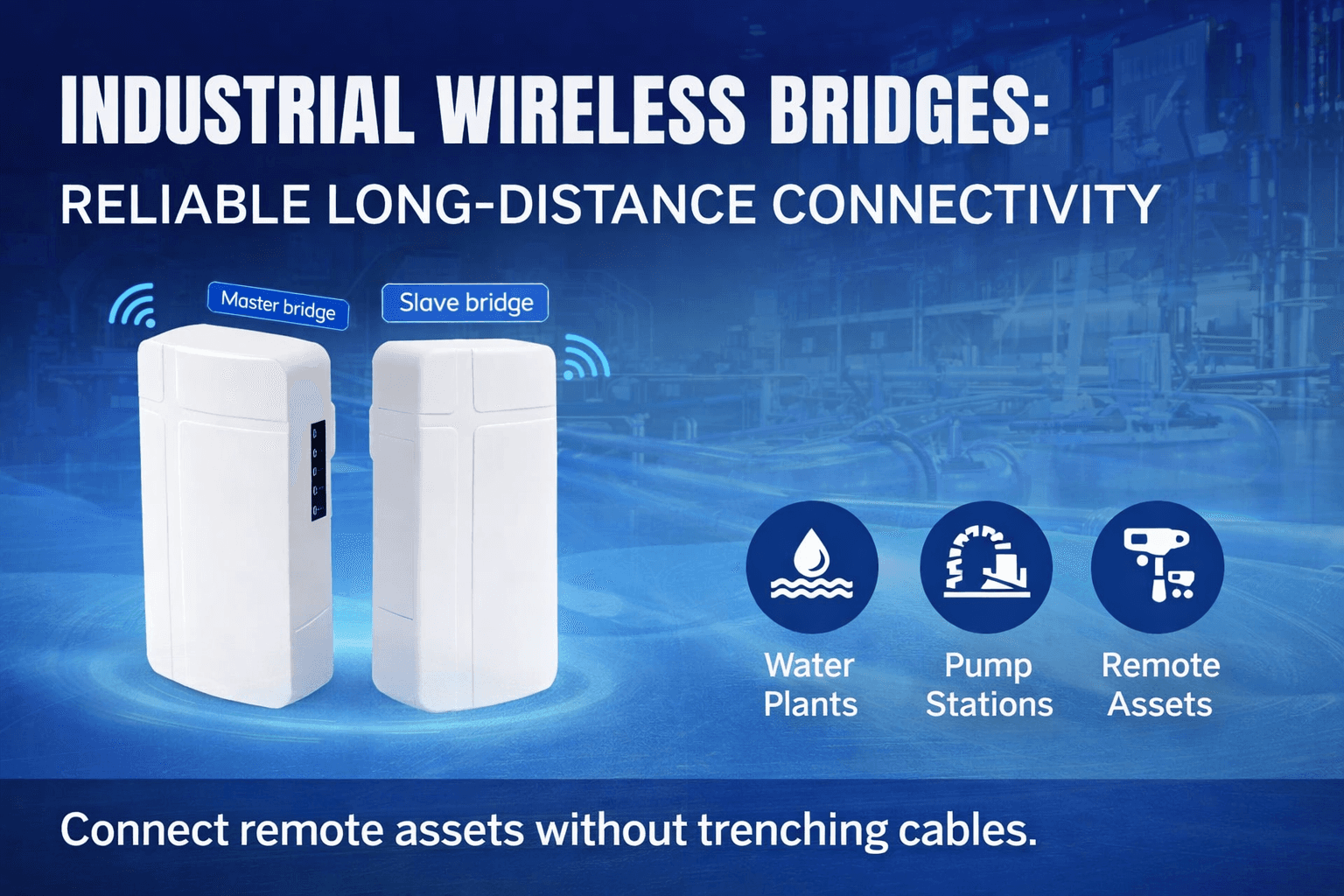
Industrial Wireless Bridges offer a smarter alternative. By enabling long-range, high-speed wireless communication, they allow facilities to connect remote systems without physical cabling, ensuring real-time visibility, control, and operational continuity.
What is an Industrial Wireless Bridge?
An Industrial Wireless Bridge is a communication device that connects two or more network points using a secure wireless link.
In simple terms, it acts as a virtual Ethernet cable, transmitting data between remote equipment and central control systems without the need for physical wiring.
These systems support:
Point-to-Point (P2P) communication
Point-to-Multipoint (P2MP) networks
This makes them ideal for linking:
PLCs and control panels
Remote sensors and instrumentation
HMIs and local operator stations
SCADA and central monitoring systems
Why Remote Connectivity is a Challenge
Many industrial systems operate across large, distributed environments, such as:
Water treatment plants with remote pump stations
Agricultural systems spanning wide land areas
Mining and utility sites in isolated locations
Industrial facilities with multiple buildings or zones
In these scenarios, traditional cabling introduces significant limitations:
High installation and trenching costs
Physical constraints across terrain or infrastructure
Ongoing maintenance complexity
Slow deployment timelines
Wireless connectivity removes these barriers, enabling faster, more flexible network expansion.
Reliable Long-Distance Communication Without Cables
APS Industrial Wireless Bridges are designed to deliver stable, high-performance communication over long distances, even in harsh outdoor environments.
Key capabilities include:
Multi-kilometre wireless range (up to ~5 km depending on model and conditions)
High-speed data transmission for industrial networks
Low-latency communication for real-time control
Stable performance in outdoor and remote conditions
This enables seamless communication between:
PLCs and control panels
SCADA systems and remote assets
Sensors and monitoring devices
CCTV and security systems
Applications Across Remote Industrial Systems
Industrial Wireless Bridges are widely used in:
Water & Wastewater Systems
Connecting remote pump stations and treatment facilitiesIndustrial Plants
Linking buildings, production lines, and control roomsAgriculture & Utilities
Enabling IoT communication across large areasMining & Outdoor Operations
Providing connectivity in remote and rugged environmentsSecurity & Monitoring
Connecting CCTV systems and surveillance networks
These applications benefit from reliable communication without the need for costly infrastructure.
Key Features for Industrial Performance
APS Wireless Bridges are engineered for demanding environments:
Long-range point-to-point communication
High-speed data transmission for PLC and SCADA networks
Support for 2.4 GHz and 5.8 GHz frequency bands
Outdoor-rated enclosures for harsh conditions
Wide operating temperature range (–40°C to +70°C)
Multiple antenna options (omni-directional and directional)
Qualcomm-based industrial wireless chipset
Secure, stable, and low-latency communication
Built for Modern Industrial Networks
Wireless bridges integrate seamlessly into existing systems, supporting:
PLC communication
SCADA platforms
Distributed Control Systems (DCS)
Industrial IoT (IIoT) architectures
They enable real-time data transmission, remote monitoring, and centralized control, all critical for modern automation environments.
From Isolation to Connectivity
Without reliable communication, remote assets operate in isolation.
With APS Industrial Wireless Bridges, facilities can:
Monitor remote systems in real time
Improve response times and decision-making
Reduce operational risk
Expand infrastructure without physical limitations
Conclusion
Industrial Wireless Bridges are an essential part of modern, distributed industrial systems.
By eliminating the need for trenching and cabling, they provide a cost-effective, scalable solution for long-distance connectivity across complex environments.
Whether connecting remote pump stations, linking plant infrastructure, or enabling industrial IoT networks, APS solutions ensure reliable, real-time communication, where it matters most.
View Product Details: https://aps-technology.com.au/product/industrial-wireless-bridges
Connect remote assets without trenching cables.
