
News
Jun 5, 2026
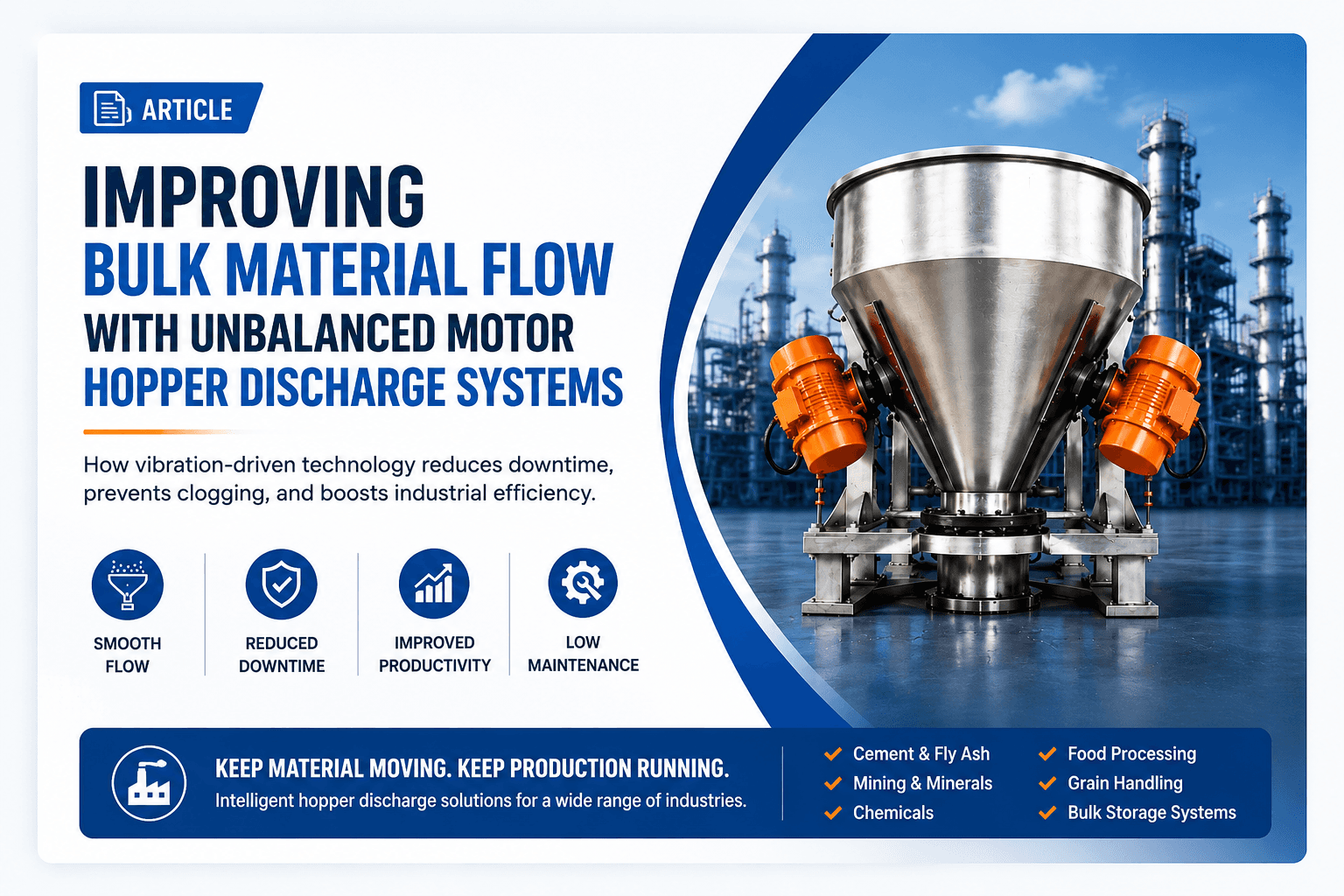
Unbalanced Motor Hopper Discharge Systems: Eliminating Material Bridging and Improving Bulk Material Flow
Bulk Handling | Industrial Automation | Process Control
In industries that handle powders, grains, minerals, fly ash, cement, chemicals, and other bulk materials, maintaining consistent material flow is one of the most common operational challenges.
Many facilities experience hopper blockages, material bridging, rat-holing, and compaction within storage hoppers and silos. These issues restrict material movement, reduce production efficiency, increase downtime, and often require manual intervention to restore flow.
While operators frequently focus on conveyors, feeders, and processing equipment, the real bottleneck often occurs much earlier in the process—inside the hopper itself.
Unbalanced Motor Hopper Discharge Systems provide an effective solution by generating controlled vibration that promotes continuous material flow, reduces blockages, and improves overall process efficiency. When combined with modern PLC and HMI control systems, these solutions become an intelligent part of a fully automated bulk handling operation.
Why Bulk Materials Stop Flowing
Bulk materials rarely behave as predictably as liquids.
Factors such as particle size, moisture content, density, temperature, compaction, and material cohesiveness can significantly affect flow behaviour inside a hopper.
Common flow problems include:
Material Bridging
Bridging occurs when material forms an arch or bridge across the hopper outlet.
Although the hopper may appear full, material cannot discharge because the bridge supports the material above it. Production stops until the blockage is removed.
Ratholing
Ratholing occurs when material flows only through a narrow central channel while material around the hopper walls remains stationary.
This reduces effective storage capacity and creates inconsistent discharge characteristics.
Material Compaction
Some materials become compacted during storage, transportation, or environmental exposure.
Compacted material resists flow and often requires mechanical assistance to restore movement.
Inconsistent Material Feed
Poor hopper flow creates fluctuations in downstream equipment such as conveyors, feeders, mixers, and processing systems, leading to reduced process efficiency and product quality.
What is an Unbalanced Motor Hopper Discharge System?
An Unbalanced Motor Hopper Discharge System is a vibration-based bulk handling solution designed to improve the discharge of materials from hoppers, bins, and silos.
The system uses strategically mounted unbalanced vibratory motors that generate controlled vibration throughout the hopper structure. This vibration breaks material bridges, prevents ratholing, and encourages consistent material movement toward the discharge outlet.
Unlike manual intervention methods, the system operates automatically and continuously, ensuring reliable material flow with minimal operator involvement.
Typical applications include:
· Cement and fly ash handling
· Mining and mineral processing
· Chemical manufacturing
· Food processing
· Grain handling
· Bulk storage systems
· Vibratory feeders and screens
· Conveyors and vibratory tables
How the System Works
The principle is simple but highly effective.
Unbalanced vibratory motors are mounted on the hopper walls or base. As the motors rotate, they generate controlled mechanical vibration throughout the hopper structure.
This vibration:
· Breaks material bridges
· Reduces wall adhesion
· Prevents material compaction
· Encourages uniform discharge
· Improves mass flow characteristics
As a result, material continues flowing smoothly through the outlet, even when handling difficult powders or cohesive bulk solids.
The system can operate continuously or intermittently depending on the application requirements.
Beyond Vibration: The APS Integrated Hopper Flow Control System
Many vibration systems stop at the motor.
APS Technology takes a broader engineering approach.
Our Integrated Hopper Flow Control System combines mechanical, electrical, and automation engineering into a single solution. The system can incorporate:
· Unbalanced vibratory motors
· PLC-based control
· HMI touchscreen operation
· Variable Frequency Drive (VFD) speed control
· Level sensors
· Motor protection systems
· Alarm management
· Optional remote monitoring and IoT connectivity
This architecture allows operators to control vibration intensity, operating cycles, and system behaviour while gaining greater visibility into hopper performance.
Intelligent Control with the APS Smart Control Panel
Modern bulk handling systems require more than mechanical equipment.
APS Smart Control Panels provide advanced control and monitoring capabilities, including:
PLC-Based Control
Industrial PLC platforms provide reliable automation and sequencing for hopper discharge systems.
HMI Touchscreen Interface
Operators can easily adjust operating parameters, monitor system status, and respond to alarms through an intuitive graphical interface.
Adjustable Vibration Timing
Custom ON/OFF cycles can be configured to suit different material characteristics and process requirements.
Adjustable Vibration Intensity
When combined with VFD technology, motor speed and vibration intensity can be optimised for specific applications.
Motor Protection and Fault Detection
The system continuously monitors motor operation and provides alarm notifications if abnormal conditions occur.
Optional Remote Monitoring
For advanced installations, system data can be monitored remotely through industrial IoT platforms and cloud-based monitoring solutions.
Technical Features
APS Unbalanced Motor Hopper Discharge Systems are designed for demanding industrial environments.
Typical specifications include:
· Supply Voltage: 415 VAC, 3 Phase
· Frequency: 50 Hz
· Vibration Force: 2 – 20 kN (customisable)
· Excitation Force: 20 – 350 kg
· Motor Power Range: 23 – 450 W
· Protection Class: IP65
· Insulation Class: F
· Cooling Method: IC410
· Continuous or Intermittent Operation
· Hopper Side or Base Mounting Options
These systems can be customised to suit different materials, hopper geometries, and operating conditions.
Applications Across Industries
Cement & Fly Ash Handling
Prevent material build-up and ensure reliable discharge from storage silos and process hoppers.
Mining & Minerals
Improve flow of ores, concentrates, aggregates, and other bulk solids.
Chemical Processing
Manage challenging powders, resins, and industrial materials while maintaining process consistency.
Food Processing
Handle flour, sugar, grains, spices, and powdered ingredients with improved flow reliability.
Storage and Hopper Systems
Maintain continuous discharge across a wide range of storage and transfer applications.
Benefits of Unbalanced Motor Hopper Discharge Systems
Implementing a properly designed vibration-assisted discharge system delivers significant operational benefits:
Improved Material Flow
Reduce bridging, ratholing, and material build-up.
Reduced Downtime
Minimise production interruptions caused by hopper blockages.
Lower Maintenance Costs
Reduce manual cleaning and intervention requirements.
Improved Safety
Decrease the need for operators to manually clear blocked hoppers.
Better Process Stability
Provide more consistent material feed to downstream equipment.
Energy Efficient Operation
Deliver effective bulk material dislodging with relatively low power consumption.
Conclusion
Hopper flow problems remain one of the most common causes of inefficiency in bulk material handling systems.
Rather than relying on manual intervention or accepting inconsistent material flow, facilities can implement intelligent vibration-assisted discharge systems that actively prevent blockages and maintain continuous operation.
APS Technology's Unbalanced Motor Hopper Discharge Systems combine proven vibration technology with advanced PLC-based control, HMI operation, motor protection, and optional IoT connectivity to create a complete hopper flow control solution.
The result is improved productivity, reduced downtime, enhanced safety, and more reliable bulk material handling across a wide range of industries.
