
Bulk Handling
Mar 21, 2026
Industrial Automation | Process Control
In modern industrial systems, monitoring alone is no longer enough.
Facilities require not just visibility, but real-time control to maintain stability, efficiency, and operational continuity.
When water conditions shift, whether due to pH imbalance, conductivity variation, or turbidity spikes, the impact is immediate:
Chemical dosing becomes inaccurate
Equipment performance declines
Process efficiency drops
Without automated response, these issues quickly escalate into downtime, waste, and increased operating costs.
👉 The solution is not just better sensing, but integrated control.
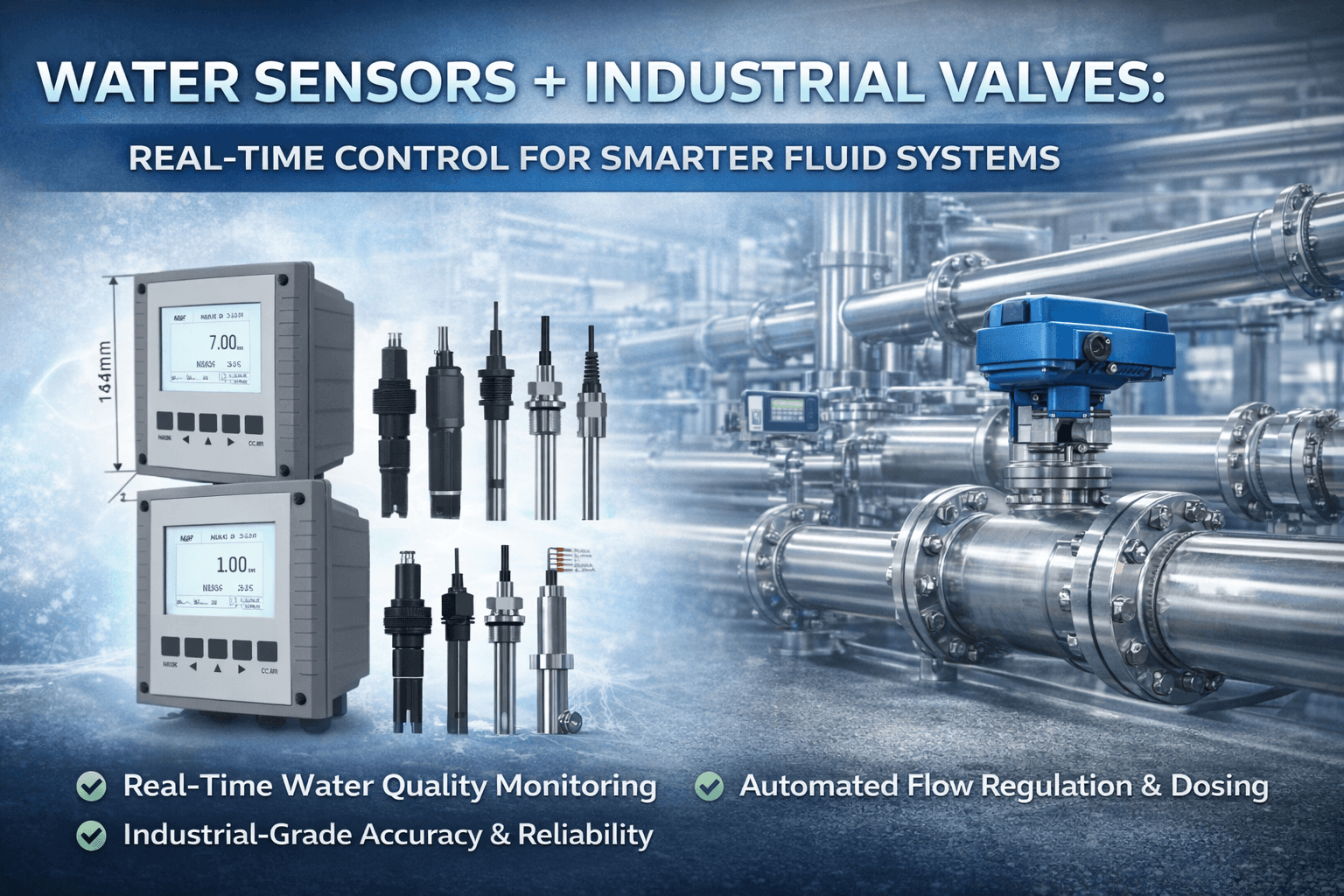
By combining advanced water sensors with heavy-duty industrial valves, facilities can implement closed-loop fluid control systems, enabling real-time correction, optimised processes, and reduced manual intervention.
What is a Water Sensor?
A water sensor is an industrial instrument used to measure key parameters such as:
Turbidity (suspended solids)
pH levels
Conductivity (ionic concentration)
Industrial-grade sensors typically use:
Optical measurement for turbidity
Electrochemical sensing for pH and conductivity
Temperature compensation for improved accuracy
Most systems support 4–20 mA and RS485 (Modbus RTU) outputs, allowing seamless integration with:
PLC systems
SCADA platforms
Industrial automation networks
From Monitoring to Control: The Role of Industrial Valves
Water sensors provide the data, but industrial valves execute the control.
APS Technology’s heavy-duty valves are designed for:
Bulk handling and chemical processing
Irrigation and fluid transfer systems
Corrosive and high-pressure environments
Constructed from stainless steel (SS316) and corrosion-resistant materials, these valves enable:
Automatic flow regulation
Precise chemical dosing control
Isolation of off-spec or contaminated fluids
👉 Together, sensors and valves form a complete control loop, where real-time data drives immediate action.
How Closed-Loop Control Works
In a modern automated system:
Sensors continuously monitor water conditions
Data is transmitted to a PLC or SCADA system
Control logic evaluates changes in real time
Valves adjust flow or dosing automatically
The system stabilises without manual intervention
This closed-loop approach ensures:
Consistent process performance
Reduced variability
Faster response to changing conditions
Applications Across Industrial Systems
Water sensors and industrial valves are widely used across industries:
Water & Wastewater
Purification systems, sewage treatment, clarifiers, RO plants
Industrial Processing
Cooling towers, boiler feedwater, chemical dosing systems
Agriculture & Aquaculture
Irrigation systems, hydroponics, fish farming
Food & Beverage
Processing lines, CIP systems, wastewater control
Harsh Industrial Environments
Reactors, high-temperature loops, corrosive processes
Across all applications, combining real-time monitoring with automated control improves efficiency, safety, and system reliability.
Key Features and System Integration
APS water sensor systems are designed for industrial performance:
Real-Time Monitoring
Immediate detection of contamination, imbalance, or turbidity changes
High Stability and Accuracy
Low drift, temperature compensation, and robust sensor design
Broad Compatibility
Suitable for clean water, wastewater, seawater, and chemical solutions
Automation-Ready
Seamless integration with PLC + HMI systems for dosing, alarms, and control
Reduced Maintenance
Self-cleaning turbidity sensors, long-life electrodes, anti-interference design
With 4–20 mA and RS485 Modbus outputs, systems support:
Remote monitoring
Data logging and trend analysis
Full SCADA integration
Industrial Reliability in Demanding Environments
Industrial applications demand durable and reliable instrumentation.
APS water sensors and valves are engineered with:
IP68 protection
Corrosion-resistant materials (SS316, PTFE)
High-temperature and high-pressure capability
Ensuring long-term performance across:
Water treatment plants
Chemical processing facilities
Agricultural systems
Infrastructure projects
From Data to Action: Smarter Fluid Systems
Water sensors provide the intelligence.
Industrial valves deliver the action.
Together, they transform operations from:
Manual → Automated
Reactive → Proactive
Monitoring → Full process control
Conclusion: Enabling Intelligent Fluid Control
Water sensors are essential for understanding system conditions, but true efficiency comes from acting on that data in real time.
By integrating water sensors with industrial valves, facilities can achieve:
Stable and optimised processes
Reduced downtime and maintenance
Lower operating costs
Fully automated fluid control systems
👉 Moving from simple monitoring to intelligent, self-regulating systems.
