
News
Mar 2, 2026
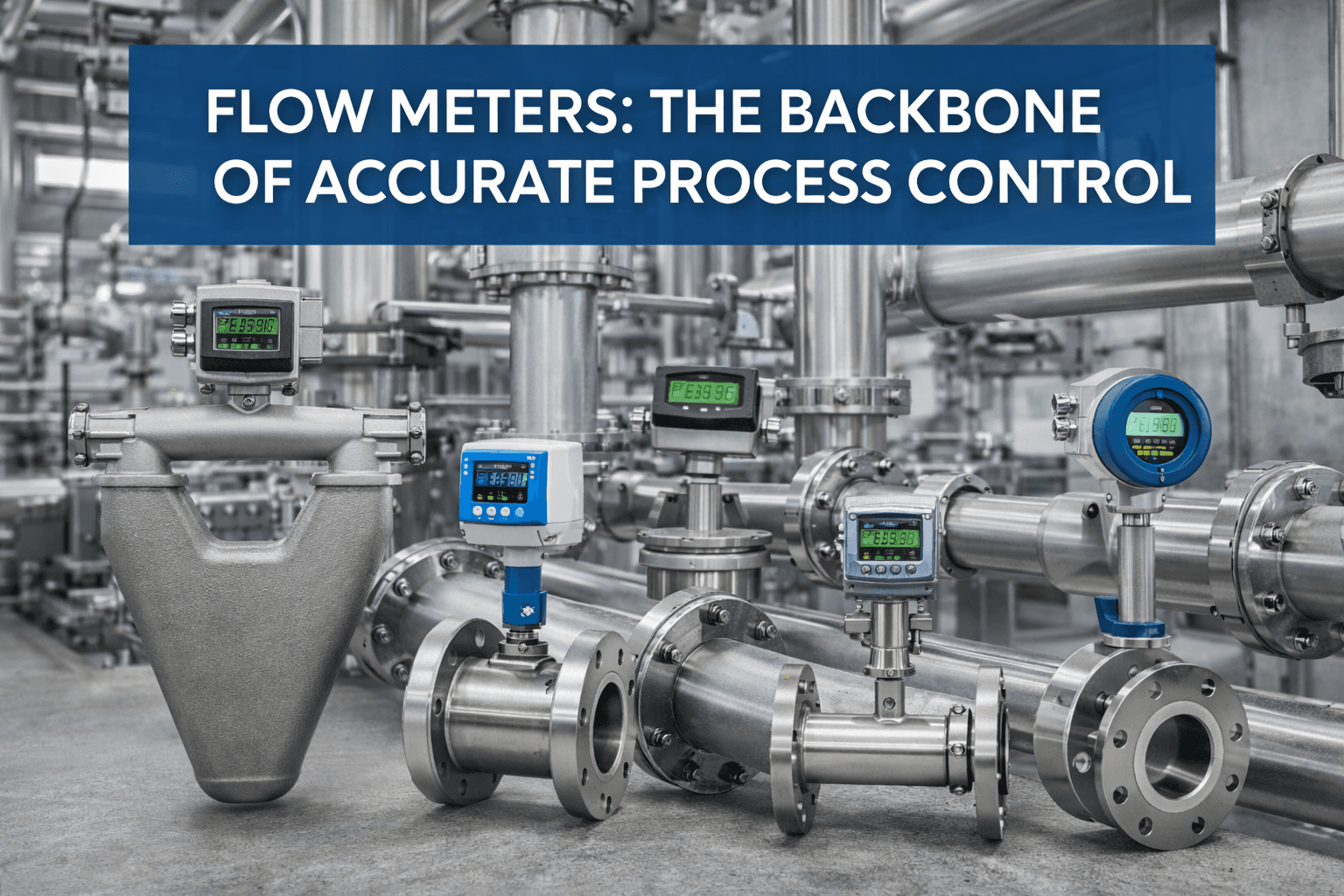
Why Flow Measurement Matters in Modern Industry
Flow measurement is not merely a monitoring function; it is a core component of process intelligence.
Across water treatment plants, chemical processing facilities, steam systems, oil and gas installations, food production lines, and HVAC infrastructure, accurate flow measurement directly influences:
Energy efficiency
Regulatory compliance
Product quality
Equipment protection
Operating costs
When flow data is inaccurate, the consequences can include overdosing chemicals, inefficient boiler operation, inconsistent product output, and unnecessary energy consumption. Over time, these inefficiencies compound into measurable financial loss.
Selecting the correct flow meter is therefore not simply a purchasing decision. It is a critical engineering choice that affects long-term operational performance.
What Is a Flow Meter?
A flow meter measures the rate, volume, or mass of a fluid — whether liquid, gas, steam, or slurry — moving through a pipeline.
Technology selection depends on:
Fluid type and conductivity
Viscosity and density
Operating temperature and pressure
Required accuracy
Integration with PLC/SCADA systems
No single technology fits every application. The key is matching the measurement principle to the process condition.
🔗 Read More about Flow Meters
Core Industrial Flow Meter Technologies
Coriolis Mass Flow Meters
Coriolis meters measure mass flow directly using the Coriolis force principle. Because they do not rely on density assumptions, they deliver extremely high accuracy — typically ±0.1% to ±0.5%.
They are ideal for:
High-value chemicals
Oil and gas custody transfer
Viscous liquids and slurriesPrecision batching systems
Coriolis meters can simultaneously measure mass flow, density, temperature, and concentration, making them suitable for advanced process environments.
Electromagnetic Flow Meters
Electromagnetic flow meters operate based on Faraday’s Law of Electromagnetic Induction and are designed for conductive liquids.
With no moving parts, they offer:
Long-term stability
Minimal maintenance
Drift-free measurement
They are widely used in water treatment, wastewater systems, chemical dosing, slurry handling, and chilled water loops.
For municipal and industrial liquid measurement, magnetic flow meters are considered a dependable workhorse solution.
Gas Turbine Flow Meters
Gas turbine meters measure volumetric gas flow using a precision rotor. They are commonly used for:
Natural gas
Compressed air
Nitrogen
Clean industrial gases
These meters perform best in clean, mid-to-high flow gas applications where consistent conditions are maintained.
Liquid Turbine Flow Meters
Designed for clean, low-viscosity liquids, liquid turbine meters provide high accuracy — up to ±0.2%.
Common applications include:
Fuel systems
Beverage production
Water batching
Clean chemical processes
They offer a cost-effective solution when high precision is required under clean conditions.
Vortex Flow Meters
Vortex meters operate on the Kármán vortex shedding principle and are widely used for steam and energy management.
They are suitable for:
Saturated and superheated steam
Compressed air
Industrial gases
With no moving parts and strong resistance to vibration and high temperatures, vortex meters are highly durable for boiler and utility systems.
System Integration & Automation
Modern flow meters support:
4–20 mA output
Pulse/frequency signals
RS485 Modbus
HART
Profibus
Foundation Fieldbus
Industrial IoT connectivity
This enables integration into PLC, SCADA, DCS, and HMI environments, transforming flow data into actionable process intelligence.
Flow measurement is no longer isolated instrumentation — it is part of a digital control ecosystem.
Inline vs Clamp-On Solutions
Inline meters provide the highest accuracy and are best suited for permanent control loops.
Clamp-on ultrasonic meters are non-invasive and ideal for retrofits, audits, and temporary measurement without shutting down the process.
Both solutions serve important roles depending on operational needs.
Why Accurate Flow Measurement Is Foundational
Accurate flow measurement enables:
Lower energy consumption
Stable process control
Reduced downtime
Reliable compliance reporting
Extended equipment life
In modern automated plants, flow is not simply monitored — it is controlled.
And control begins with accurate measurement.
Conclusion
A complete flow measurement portfolio — including Coriolis, electromagnetic, gas turbine, liquid turbine, and vortex technologies ensures that every industrial application is matched with the correct solution.
Flow measurement is not optional.
It is foundational to efficient, compliant, and profitable operations.
Power Smarter Process Control with APS Technology
If you need assistance selecting the right flow meter for your application, APS Technology provides technical consultation, sizing support, and application-specific recommendations.
Contact APS Technology today to ensure your process is measured correctly and controlled intelligently.
📩 For inquiries, demos, or partnership opportunities, contact us at
📧 info@aps-technology.com.au
