
Bulk Handling
Mar 21, 2026
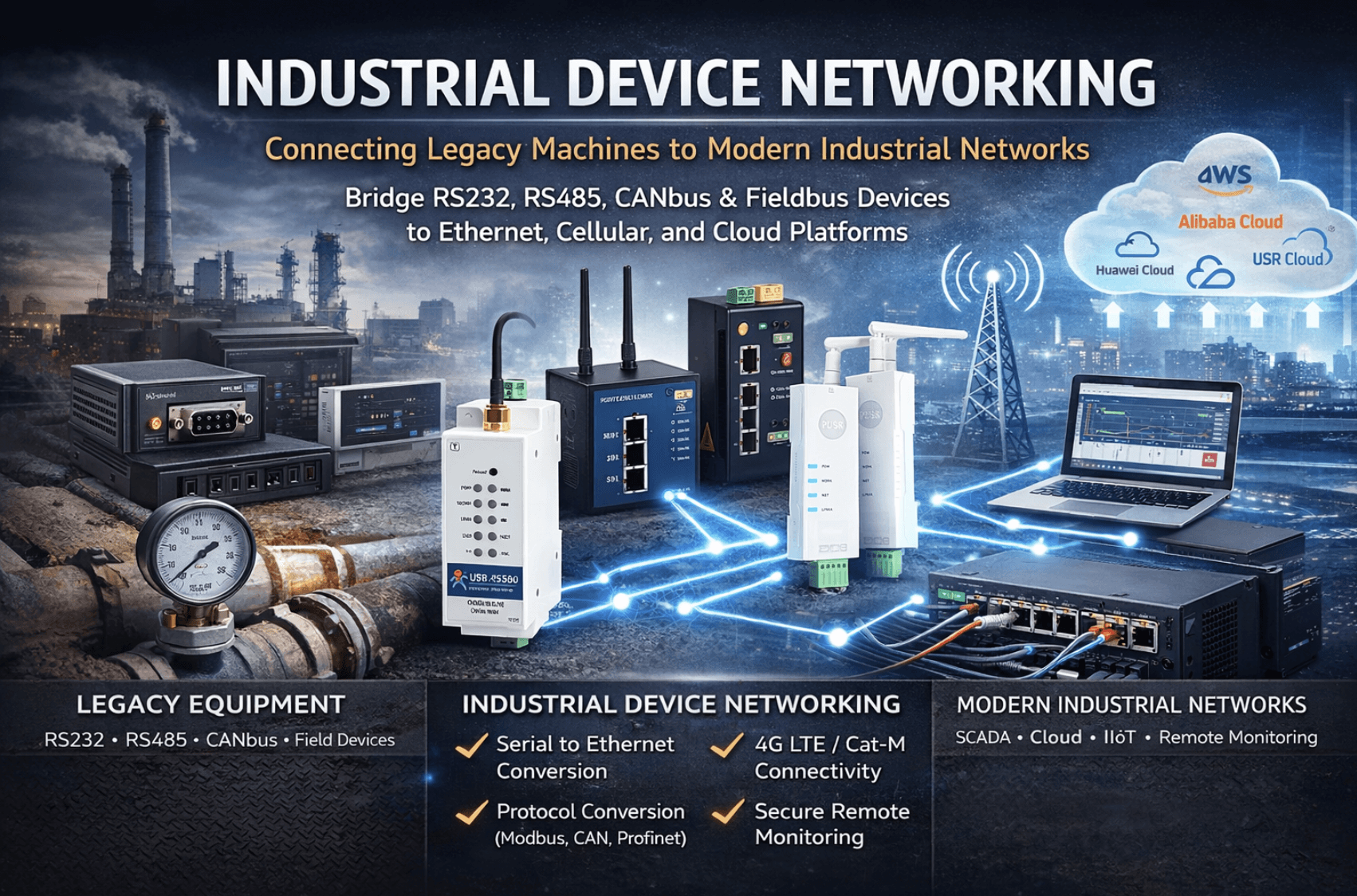
Industrial Automation | IIoT | Industry 4.0
Many industrial facilities still rely on legacy equipment, machines that were never designed to connect to modern networks.
These systems often operate in isolation, communicating via RS232 or RS485 protocols, with limited visibility, no remote access, and minimal integration into higher-level control systems.
Replacing them is expensive.
But leaving them disconnected is even more costly, in lost efficiency, downtime, and missed insights.
This is where Industrial Device Networking becomes essential.
The Challenge: Legacy Machines in a Modern Industrial Environment
Modern industrial operations require:
Real-time data visibility
Remote monitoring and diagnostics
Integration with PLC, SCADA, and cloud systems
However, many existing machines:
Use serial communication protocols (RS232 / RS485)
Cannot connect directly to Ethernet or IP-based networks
Operate as isolated, standalone systems
This creates a critical gap between legacy infrastructure and modern automation requirements.
What is Industrial Device Networking?
Industrial Device Networking refers to the technologies and architectures used to connect legacy industrial equipment to modern communication networks.
In practical terms, it means:
Converting serial data → Ethernet → IoT/cloud-ready communication
This is achieved through:
Serial-to-Ethernet conversion
Wireless connectivity (4G, WiFi, LoRa)
Protocol translation between different industrial systems
As a result, older machines can communicate seamlessly with modern automation platforms, without requiring full system replacement.
Key Technologies Enabling Connectivity
Serial Device Servers
Convert RS232 / RS485 / RS422 devices into Ethernet-enabled systems
Allow legacy equipment to connect to TCP/IP networks
Enable integration with PLCs, SCADA, and remote monitoring platforms
Industrial Cellular Modems
Provide remote connectivity via 4G/LTE networks
Ideal for unmanned, mobile, or geographically distributed assets
Enable secure, always-on communication
Protocol Converters
Translate between industrial protocols (Modbus, CANopen, Profinet, EtherCAT)
Ensure interoperability across different systems and vendors
Simplify integration of mixed environments
LoRa Communication Devices
Offer long-range, low-power wireless communication
Suitable for remote sensors and distributed industrial applications
Enable connectivity in areas without traditional network infrastructure
Industrial Applications
Industrial Device Networking is widely used to modernise existing systems:
Integrating legacy machines into PLC and SCADA environments
Remote monitoring of pumps, tanks, and utility assets
Upgrading serial devices for IIoT connectivity
Connecting distributed equipment across large industrial sites
Enabling remote diagnostics and predictive maintenance
Benefits for Industry 4.0
Industrial Device Networking allows businesses to modernise operations without replacing existing assets.
Key benefits include:
Extending the lifespan of legacy equipment
Enabling real-time data visibility and control
Reducing capital expenditure (CAPEX)
Improving operational efficiency and uptime
Supporting remote access and automation
Accelerating Industry 4.0 adoption
From Isolation to Integration
Instead of replacing entire systems, industrial device networking creates a bridge between legacy infrastructure and modern technology.
A typical architecture may include:
Legacy devices communicating via RS485 (Modbus RTU)
A gateway or device server converting data to Ethernet (Modbus TCP)
An IoT router enabling remote monitoring and cloud integration
This structured approach ensures reliable communication while avoiding conflicts and maintaining system stability.
Conclusion: Unlocking Value from Existing Systems
Industrial Device Networking is not just about connectivity, it’s about unlocking the full value of existing assets.
By connecting legacy machines to modern networks, industries can:
Improve visibility
Enhance control
Enable smarter decision-making
APS Technology’s solutions, combining device servers, IoT gateways, and industrial communication technologies, help transform isolated systems into connected, intelligent, and future-ready operations.
Upgrade legacy equipment without replacing machines.
Learn more about Industrial Device Networking solutions:
https://aps-technology.com.au/product/networking-devices
